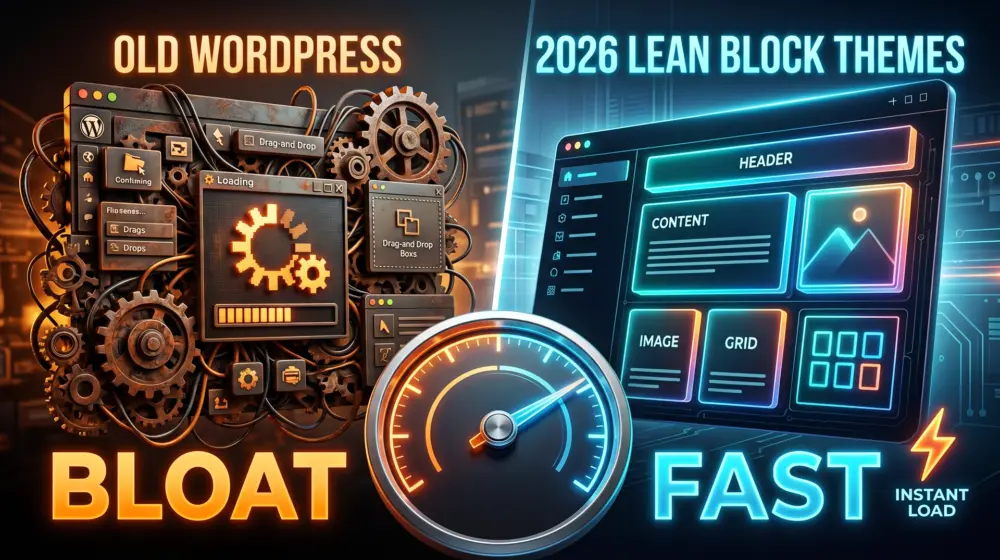
For over a decade, the WordPress ecosystem was a battlefield of "Heavyweight Champions." If you wanted a professional website without touching code, you reached for Elementor, Divi, or Beaver Builder. They were the kings of the "Drag-and-Drop" era.
But as we settle into 2026, a seismic shift has occurred. The "bloat" that once felt like a necessary trade-off for design freedom is now a liability. With Google’s Core Web Vitals becoming more aggressive and users demanding instant load times, the industry is witnessing a "Great Migration."
Welcome to the era of Lean Block Themes.
In this article, we’ll explore why the traditional page builder era is fading and why WordPress FSE (Full Site Editing) paired with themes like Kadence and Blocksy has become the new gold standard for performance and SEO.
1. The Bloat Crisis: Why Heavy Builders are Losing Ground
In the early 2020s, the "all-in-one" builder was the dream. However, that dream came with a hidden cost: excessive code.
The "Domino" Effect of Bloat
When you use a heavy builder like Elementor or Divi, your site doesn't just load your content. It loads:
- Massive CSS libraries for every possible design widget.
- Heavy JavaScript files for animations you might not even use.
- A "DOM" (Document Object Model) that is often 5x deeper than it needs to be.
The 2026 Performance Gap
Recent 2026 benchmarks show a staggering difference in Interaction to Next Paint (INP) Google's latest metric for responsiveness. While a standard Elementor page might take 200-300ms to respond to a click due to script execution, a lean block theme typically responds in under 50ms.
| Metric | Elementor / Divi (Avg) | Lean Block Themes (Kadence/Blocksy) |
| Google PSI Score (Mobile) | 65 - 82 | 95 - 100 |
| Fully Loaded Time | 1.8s - 3.2s | 0.4s - 0.8s |
| Page Size | 500KB - 1.2MB | 40KB - 150KB |
| HTTP Requests | 40+ | 10 - 15 |
2. WordPress FSE vs. The Big Five (Elementor, Divi, Beaver Builder, Breakdance, SeedProd)
The core of this revolution is Full Site Editing (FSE). It’s no longer just about writing a blog post; it's about designing your entire site headers, footers, and templates directly in the WordPress core.
Why the "Old Guard" is Pivoting
- Elementor & Divi: To survive 2026, these giants have launched "lite" versions and performance-focused updates (like Elementor’s Atomic Editor). However, they are still "wrapper" technologies, they sit on top of WordPress, adding a layer of complexity.
- Breakdance: A strong middle ground that focuses on performance but still relies on a proprietary builder engine.
- SeedProd: While excellent for landing pages, it lacks the deep integration that native blocks offer for complex, dynamic site-wide data.
The Gutenberg Performance Advantage
Gutenberg isn't just an editor anymore; it's a layout engine. Because it's native, it doesn't need to "re-interpret" your design. The code you see in the editor is almost exactly what gets shipped to the browser. Gutenberg performance is now synonymous with "Native Performance."
3. The New Kings: Kadence, Blocksy, and GeneratePress
If the "Heavy Builders" are the SUVs of the web, powerful but gas-guzzling, then themes like Kadence, Blocksy, and GeneratePress are the Electric Supercars.
Kadence: The Feature Rich Speedster
Kadence has become the top choice for developers in 2026 because it offers a "Builder-like" experience without the performance hit. Its Kadence Blocks plugin allows for advanced layouts (row layouts, sliders, tabs) using only native WordPress logic.
Blocksy: The Design Powerhouse
Blocksy is often cited as the most "beautiful" lean theme. It leverages modern CSS (like CSS Grid and Flexbox) to provide deep customization in the Customizer without adding a single kilobyte of unnecessary JavaScript.
GeneratePress: The Lightweight Legend
For those who want raw speed above all else, GeneratePress Premium remains the benchmark. It is the theme of choice for high-traffic niche sites where every millisecond equals revenue.
4. Full Site Editing (FSE): The Death Blow to Proprietary Builders?
In 2026, WordPress FSE has matured to the point where even non-technical users can build stunning headers and footers without a third-party plugin.
Pro Tip: In the past, you needed Elementor Pro to design a "Custom Single Post Template." Today, you can do this in Appearance > Editor using nothing but core blocks.
The SEO Benefit of Lean Themes
Search engines prioritize "Content over Chrome." A lean block theme ensures that your actual content the text and images is the first thing the crawler sees.
- Lower Bounce Rates: Fast-loading sites keep users engaged.
- Better Mobile Indexing: Google’s mobile-first index favors the lightweight code of FSE themes.
- Clean Markup: Semantic HTML (using
<header>,<main>,<footer>) is handled better by native blocks than by the "nested div soup" of older builders.
5. Transitioning in 2026: Should You Switch?
If you are running a successful site on a builder like Elementor, do you need to delete everything tomorrow? Not necessarily. But for new projects or major redesigns, the choice is clear.
Use a Page Builder if:
- You are an agency with a massive library of pre-built Elementor/Divi templates.
- You need highly specific, "flashy" animations that blocks can't yet replicate easily.
Use a Lean Block Theme if:
- Core Web Vitals are a priority for your SEO strategy.
- You want a site that remains stable across future WordPress updates.
- You want to avoid the "subscription fatigue" of paying for builder licenses every year.
Final Verdict: The Lean Revolution is Here
The "Death of Page Builders" isn't a sudden event, but a gradual transition toward efficiency. In 2026, the trend is clear: Fast is the new beautiful.
By embracing WordPress FSE, Gutenberg performance, and fastest WordPress block themes like Kadence or Blocksy, you aren't just building a website, you are building a future-proof digital asset.
Whether you’re a seasoned developer or a small business owner, the shift toward a leaner web is something we can’t ignore. As we move further into 2026, the priority has clearly shifted from "how many features can we add" to "how fast can we make it load."
The era of the "Heavyweight" builder isn't necessarily over, but it is certainly being challenged by a faster, cleaner, and more native way of building.
What about you? Are you still team Elementor/Divi for the design flexibility, or have you made the switch to a Lean Block theme like Kadence or Blocksy?
Drop a comment below and let me know your experience, I’d love to hear your thoughts on whether the performance gains are worth the learning curve! If you found this guide helpful, don’t forget to share it with your fellow WordPress enthusiasts to help them speed up their sites.
